Monday, February 20, 2017

Tornado disaster relief with Red Cross

http://www.wdsu.com/…/red-cross-responds-to-new-orl…/8730091


Volunteer hours for this activity: 16
Total volunteer hours this semester: 16

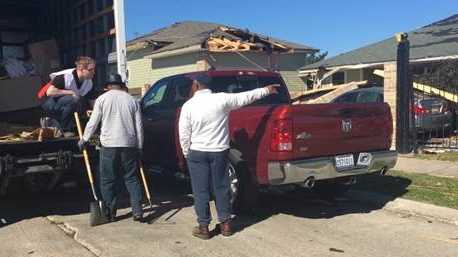
On February 7th, 2017 an EF-3 tornado struck the New Orleans area. On February 10th, and 11th, I volunteered with the Red Cross.

Some of the heaviest property damage occurred in New Orleans East, so that is where they sent me with a truck full of rakes and shovels. A full-time volunteer drove, while I hung out in the back. We traveled down the streets where we could see the most debris. When we spotted people outside working to clean up the mess, we would ask them if they wanted a rake and a shovel. Every time, they said yes, and eagerly came to grab one of each.

The tornado produced some interesting patterns of damage. One house would be leveled, while the house next door was untouched. I saw a lot of the lucky people assisting their less lucky neighbors. A few families already had lumber delivered and were starting to rebuild.

I got to meet a lot of New Orleans residents. They all seemed to be in good moods despite the unfortunate event. It seemed like they had all been through this before, and knew what to do.

Working with the Red Cross was an interesting experience. The operation is unique and it is managed so differently than anywhere else I have worked. The workers had a sense of calm, and confidence that appeared to be rooted in the knowledge that they were doing good work. The main manager was driven and attentive. However, the atmosphere lacked the organization and sense of urgency that is universal in competitive businesses.

There were things that I would do differently if I were king. For example, I think it was an unnecessary impedance for us to have each resident sign a form before getting getting their rake and shovel. I also think it would have been OK to let them pick up one for their neighbors instead of being so strict (I broke that rule several times). There was also way too much sitting around the office before we embarked to the location.

There is always room for improvement in any organization. I really respect and admire the Red Cross, and their work. I had a good time, I hope I made a small positive contribution by doing the manual labor of passing out equipment. I also gained some understanding of the strong sense of community that the New Orleans residents share.

Wednesday, November 30, 2016

Idle Hands

Total number of service hours completed in November: 0
Total number of hours completed this semester: 50+

Since my service hours are complete, I'll use this months post to reflect on my experience in the Pharm masters program.

The course administrators have been perfectly adequate. I started the semester with some frustration and disappointment. I was hoping to jump into lab work. I read up on some of the projects I wanted to be involved with. I spoke with a professor and we agreed that I would start working after the second exam. However, when I returned at that time, with my shiny new lab coat ready to go,  he informed me that he had unexpectedly taken on two undergrads and no longer had a spot for me. (UNDERGRADS?!?)

Since that rejection, I've been spending the majority of my time working at my restaurant job. I realize there are plenty of other research opportunities and I'll try to got in somewhere for next semester and the following summer.

So far, I have put less effort into the course materials than I would have liked, and I will take some steps to remedy that next semester. I am really hoping to finish strong this fall with a good score on the last exam. My biggest obstacle has been an internal resistance to the concept of lectures. I struggle to see the relevance or importance of listening to a professor talk through material that is covered in so many books and online videos. So far, my only test preparation has been skimming through the corresponding chapters of a pharmacology text book the night before the exams. The results have been okay, but here is plenty of room for improvement especially since the test questions are drawn from lecture materials. We are currently in the gastrointestinal block, which is a good review of some previously covered drugs. There is also no GI section in my text book, so this will be an interesting exam.

As I move forward, I'm going to try to silence my rebellious nature, and instead just trust the process.

Tuesday, November 1, 2016

All done.

     The Science Fair is completed. I put in around 50 hours this semester in Dr. Loftus' biology classes. This feels like a good stopping point. It was an experience.
      Every one of my visits was pretty similar. I would walk around field questions, and ask a few  in attempts to keep the students on task. Toward the end of the class period, I would work with a student or two who had fallen behind on assignments.
      The assignments were easy for them. Nitrogen cycles, food webs and even the evolution of antibiotic resistance are concepts they can grasp rapidly. We could bust through those assignments and get the kid caught up pretty quickly.
      I had the advantage of only seeing them once a week, and I never had to hand out detentions or grade reductions. However, I'm convinced that the usual angry lectures and punishments are counterproductive for motivating a child. From my limited, outside perspective, it seems that even at the high school level students benefit from having someone say, "Let's get it done now. Let's try to get an A." That little bit of initiative seemed to be helpful.
      By far, the most significant impression that I will take away from my volunteer experience this semester is from observing the selflessness of the teachers and the mammoth effort that they put into their work each day for such little recognition and reward. 


Sunday, October 2, 2016

September

I've put in another month of weekly volunteering in the biology class at SciHigh. I'd like to get some photos, The class is fast paced and busy, so the photo opps can be difficult to make time for, but I'll work on it. I'm posting a picture of the visitor name tags that I get at most of my visits (although sometimes they are out of them.)

I enjoy working with the students, and I hope I have made at least a small positive contribution. The students are all memorable, but the most striking part of this experience has been the amount of energy and dedication that Dr. Loftus puts into his classroom. The lesson plan is always packed with thought-out, thoroughly prepared activities. His work-ethic, and polished teaching ability enable him to keep the students engaged in the material.

This month, the students continued to learn about food webs and nutrient cycles. They are also working on their projects for the upcoming science fair.

Dr. Loftus intentionally allows the students lots of freedom on these projects. I make rounds to each group and try to provide a tiny bit of direction amidst the chaos. I've been able to streamline some of their procedures with little things like making one large master mix of reagents and then distributing an aliquot to each reaction vessel instead of mixing them all individually.

My most defined duty has been to work one-on-one with students who have fallen behind on their project deadlines. We sit down in the library and outline quick and easy experiments that are structured around the ideas they provide. The difficulty is I am only there once a week, so there is little time to clarify, follow-up, or troubleshoot. I turn them loose, and then they are on their own to complete the project. I hope they are having fun, and I am looking forward to seeing what they present at the fair.

24 hours of volunteer work completed.

Wednesday, August 31, 2016

High School Teachers are Saints... ...and Axolotls are Awesome.

The activity I participated in was the biology class at The New Orleans Charter Science and Mathematics High School. At the time of this posting, I have been there three times, for two classes each visit.
       The classes are taught by Dr. Sam Loftus. He may very well be the world's greatest high school biology teacher. His classroom is stocked with books, anatomical models, and aquariums. Fortunately for me, he was receptive to having me join two of his classes each week this semester. I showed up ready to contribute in whatever small way Dr. Loftus asked for. I said that I'd be happy to set up reagents, grade papers, or sweep the floors. However, when I arrived, his instructions were much less constrained. "Just walk around and answer questions," he said.

        On my first visit, the students worked on a written worksheet regarding experimental design. The following week, some new additions arrived, and the four aquariums at the corner of the classroom each contained an adult axolotl. These amphibians generated a lot of interest from the students. Dr. Loftus explained the concepts of phenotypes, albinism, melanism, and GFP.  At Week 3, we began a project to create mini-biospheres out of jars containing shrimp, swamp water, and aquatic plants. As they worked on assembling the parts, I guided the students on how to zero a balance, measure mass, and use an oxygen probe to measure dissolved O2.

       The students are friendly and respectful, but like any teenagers, they are susceptible to distraction. When the students were occasionally disruptive I considered asking them to be quiet and focus, but I probably lack any authority, and I would rather have them see me as just a fellow science enthusiast. So instead of barking orders I try to keep them on task by asking them to explain a topic to me. When a group of students appears to have gotten side tracked, I sit down at their table and say something like, "Can you tell me how you got your answer for number five?" or “What is the independent variable?” This seems to work. The students readily share their understanding and discuss ideas.

       I am looking forward to assisting with their projects and seeing their performance as they work toward the science fair that will take place in October. I will post some pictures.